
Extraordinary Ministers of Holy Communion
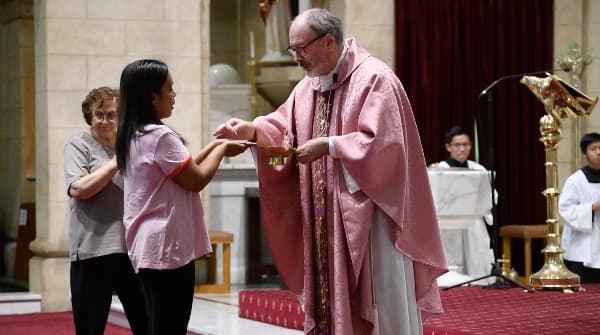
Mission:
The primary mission of the St. Mary’s Extra Ordinary Eucharistic Ministers is to assist the priest at Mass in distributing the Body and Blood of Christ to the faithful in Holy Communion. Additionally, many Eucharistic Ministers also bring Communion to the sick and homebound.
In 1910, Pope Pius X called for Catholics to receive Holy Communion frequently. Under Pope Paul VI the option of Communion by the hand was restored, and the Second Vatican Council called for the Precious Blood of Christ to again be offered to the faithful. In 1973, the document Immensae Caritatis was promulgated, allowing lay persons to act as ministers of Holy Communion as in the early centuries of the Church. This permission was given in direct answer to the needs of the Church. With more people receiving Communion frequently and under both forms, laypersons were needed to assist priests with the following tasks:
- Distributing Communion at Mass.
- Bringing Communion to the sick and homebound.
Eligibility:
To serve as a Eucharistic Minister one must be at least 16 years old and a Confirmed, practicing Catholic. Applicants for this ministry must be approved by Parish Priest Father Des Moloney.
Serving as an extraordinary Minister of the Eucharist is a great privilege, and one the lay person should consciously seek to remain worthy of Pope Paul VI put it this way:
“The person appointed for this task must be duly instructed and should distinguish himself or herself by Christian life, faith, and morals, striving to be worthy of this great office, cultivating devotion to the Holy Eucharist, and acting as an example to the other faithful by piety and reverence for this most holy sacrament of the altar. Let no one be chosen whose selection may cause scandal among the faithful.”
In other words, lay ministers should strive to live a life consistent with the sacrament they are distributing. They must be faithful to Mass each Sunday, and witness the faith in their daily lives.
Each Mass at which a minister serves should be preceded by prayer and careful observance of the Eucharistic fast (nothing but water or medicine for 1 full hour before receiving Communion). The Sacrament of Reconciliation should also be embraced as a means for preparing to receive and distribute the Eucharist. The minister should seek to grow in their devotion to the Eucharist by prayer and spiritual reading. Taking part in Adoration and or Benediction of the Blessed Sacrament is also encouraged.
Contact:
For further information, scheduling requests, or to apply to be a Eucharistic Minister, contact: Carmen D'Rosario 9370 6688 ascotvale@cam.org.au
Eucharistic Homebound Ministry:
“The gift of life, God’s special gift, is no less beautiful when it is accompanied by illness or weakness, hunger, loneliness or old age. At these times human life gains extra splendor as it requires our special care, concern and reverence. It is indeed in and through the weakest of human vessels that the Lord continues to reveal the power of God’s love.”
– Terrence Cardinal Cooke, 1983
Members of St. Mary’s parish regularly minister to those who are unable to leave their residence (for short or long term) by providing regular pastoral visits and the reception of Holy Communion. Homebound visitors provide support to homebound persons through their presence and careful attention.
Pastoral visits are an opportunity to make God’s presence immediate and real to the homebound person through prayer and the reception of Communion. The early Christian community began the practice of bringing Communion to those who were unable to gather with the community. Today this practice is still an important ministry in the Church. The worshiping assembly embraces and prays for those unable to be present and commissions some of its members to go forth and bring the Body of Christ to its absent members.
Praying with another person can be a very powerful means of sharing our relationship with God and bringing His real presence to the homebound. This prayer may take the form of praise and thanksgiving, petition for needs, an opportunity to express feelings, requests for forgiveness, for healing or longing for a closer relationship with God and the community. Whatever the need, the minister can be a caring partner in the prayer.
The homebound minister also provides social conversation according to the needs and desires of the homebound. This provides a congenial atmosphere for such things as swapping stories, catching up on current events or getting to know each other.
St. Mary’s has trained homebound ministers who are available to visit those who are unable gather with the assembled community providing the reception of communion, being a prayer partner and engaging in social conversation. These visits are arranged at the mutual convenience of the homebound person and the visiting minister.
Spirituality of the Ministry:
The True Presence: Once the bread and wine are consecrated by a priest at Mass, they become the Body and Blood of Christ. The outward appearance of bread and wine is preserved, but in their essence these gifts become Christ Himself. Each Eucharist is a new Incarnation as God “takes flesh” among His people to strengthen and guide them on their pilgrim way. God is truly present in the Eucharist, and receiving Communion is the closest we will get to Him before we meet Him face to face in the life to come.
Mother Mary: There is no more perfect model for a Eucharistic Minister than Mary. Mary carried the Body of Christ for 9 months, and brought Him to the whole world as gift. The Eucharist you will distribute is a sign and symbol of this beautiful act of love. Mary was the God Bearer, something all Baptized Christians are called to be. And God chose Mary for her humility and purity, the most important characteristics for a good Eucharistic Minister.
EXTRAORDINARY MINISTER OF HOLY COMMUNION
ST MARY'S PARISH
Introduction / Preparatory
- (St. Mary's) come to sacristy about ten minutes before the beginning of Mass
- ensure you are dressed befitting this ministry (e.g. no shorts, t-shirts, runners, thongs)
- (St. Mary's) the minister processes in front of the celebrant in approaching the altar. All genuflect together with the celebrant, then go to their seats in the front section close to the centre aisle
Approach/ Movements for the Ministry
- approach the altar as the celebrant drinks from the chalice, bow and proceed to use the hand sanitiser
- after you have received Communion depending on the celebrant he may give a blessing
- be alert to any disabled person who may be given Communion first
Gestures and Conclusion
- hold the Eucharist at a medium height and make eye contact as you say, The Body of Christ
- for those signalling their desire for a blessing, simply hold out your hand toward the and say, May God bless you as you make eye contact with them. Do not touch them or perform gestures in the sign of cross over or toward them
- be alert for those who wish to receive the Eucharist on the tongue and exercise care when placing the Eucharist
- if the Eucharist is dropped it may happen that the communicant picks it up and consumes. If not, pick up the Eucharist and place discreetly to the side of the ciborium or communion bowl. This host may be distributed or consumed later
- be alert to anyone who appears to walk away without consuming the Eucharist. It may be possible to have the next person follow and ensure that the person consumes
- at the conclusion of the time of Communion return the vessel to the altar and wait at the side of the altar. Turn toward the tabernacle as the priest goes there. Then, leave the sanctuary once the celebrant returns to the altar
- (St. Mary's) immediately after the Blessing and Dismissal join the celebrant and other ministers at the foot of the sanctuary. Then, process to near the back door of the church from where you may proceed back to the sacristy