
Eucharist
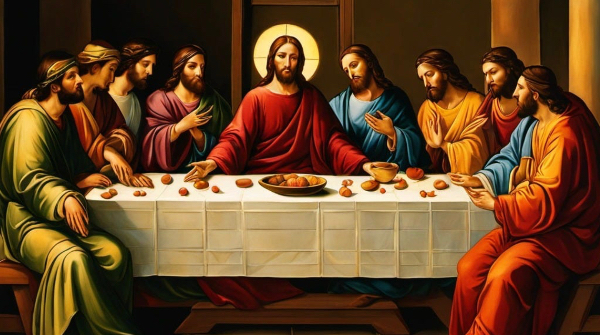
It is Jesus who feeds us in the Eucharist, the source and summit of the Christian life. In this celebration the death and resurrection of Christ is re-enacted and re-actualised. (CCC 1324).
The Eucharist Is Not a Symbol: Beyond Symbolism
Jesus is substantially present—body, blood, soul, and divinity—in Holy Communion. People may misunderstand and believe that the Eucharist is only a symbol of the body and blood of Christ. It is much more than that.
We refer to this as the Real Presence of Jesus in the Eucharist. Think of the Real Presence as the core of what the Eucharist is: in other words, its “substance.” In addition, after the consecration, look at the bread and wine as external characteristics or “accidents” that visibly endure without change; aspects like colour, size, shape, or any other observable feature.
In offering the Sacrament of the Eucharist, the substance of bread and wine change into the body and blood of Christ, while the accidents (taste, appearance, etc.) remain unchanged.
Defining the Eucharist
The term “Eucharist” comes from the Greek word eucharistia, which means “thanksgiving.” In Catholic Tradition, the Eucharist is a sacrament—and sacrifice—of thanksgiving and communion. We gather at Mass and Holy Communion to express gratitude to Jesus for his sacrifice on the Cross, and to offer anew that one sacrifice under the forms of bread and wine.
Receiving the Eucharist unites us more closely as the body of Christ within the Church.
St. Paul emphasizes that the Church is one body (see 1 Cor. 12:12–30). Through the consecrated bread, we become the body of Christ. “Since there is (only) one bread, we though many are actually one body because we all share in the one bread.” (1 Cor. 10:17; see 10:14–22).
The one body—and divine Person—of Jesus Christ has the power to make us one. We the Church are one body because we are the mystical body of Jesus Christ in the world today.
Acting in the Person of Christ
During the celebration of the Eucharist the priest, acting in the person of Christ (in persona Christi), “re-presents (makes present) the sacrifice of the cross” under the sacramental forms of bread and wine (CCC 1366). This is the sacrifice of the Mass.
During Holy Mass, the priest wears clothes called “vestments” to show he represents Christ, not himself. The priest reflects an image of Christ, who is the “high priest of the New Covenant” (CCC 1348). When a priest offers the Eucharist, he uniquely and most powerfully makes Jesus present to and for the benefit of the faithful, and the world at large as well.
Sacrifice of the Cross: Celebrating Redemption
The celebration of the Eucharist makes present the sacrifice of the cross. Jesus offered his body and blood on the cross to save humanity. We don’t repeat or multiply his one sacrifice at Mass, but we do powerfully offer it anew.
The Eucharist re-presents Christ’s one sacrifice. When the priest speaks the special words, he makes present—and we join ourselves in offering anew to our Father in heaven—Jesus’ redemptive sacrifice. This participation makes the Eucharist a holy and saving action.
Words of Christ: A Promise of Eternal Life
We have the words of institution from Jesus Christ himself at the Last Supper: “Take and eat, this is my body” and “Drink from it, all of you, for this is my blood” (Matt. 26:26–28).
This offering renews our unity with God. Through these words, Christ gives us eternal life by giving us himself. He invites us to join in—and partake of—his sacrifice, so that we can share everlasting life in heaven with him.
The Role of the Holy Spirit
The Holy Spirit plays a pivotal role in the celebration of the Eucharist. Through the power of the Holy Spirit, the bread and wine become the Body and Blood of Christ:
“The power of the words and the action of Christ, and the power of the Holy Spirit, make sacramentally present under the species of bread and wine Christ’s body and blood, his sacrifice offered on the cross once for all” (CCC 1353).
Holy Communion for the Sick
Sick and elderly parishioners unable to attend Sunday Mass are encouraged to ask for Holy Communion to be brought to them. (Don’t be reluctant to ask – the parish is here to serve you, and we very much want to bring the Eucharist to you: this is a central part of what we are here for! The Eucharist is the heart of our lives.)
Our normal arrangement is that parishioners who are Extraordinary Ministers will bring Holy Communion to your house at an agreed time on the afternoon of the 3rd Sunday of the month.
If you wish, two or three other weeks of the month, usually on a Wednesday, one of the priests or one of the Extraordinary Ministers will bring Holy Communion at an agreed time. When the priest visits, he is also able to administer the Sacrament of Anointing of the Sick and/or the Sacrament of Reconciliation to those who wish to receive them.
Contact the Parish Office for further details.