
Baptism
The Process of Baptism
For Baptism at either St Patrick's Church or St Kevin's Church, you are required to meet with the Parish Priest beforehand. This is a great opportunity for us to get to know you better, and here the priest will assist you to fill in the necessary paperwork.
Baptism preparation is on the first Sunday of allocated months.
After attending the Mass at St Patrick's Church, Murrumbeena you are then taken down to Rovira House (a short walk from the Chruch) for education and a question and answer session on baptism. This goes for one hour.
The Baptism itself occurs on the third Sunday of each allocated month at 9 am Mass at St Patrick's Church, Murrumbeena.
If you prefer for the ceremony to occur at St Kevin's Church, Ormond: then the Baptism will occur on the third Sunday at 10.30 am Mass. Please note we do not offer Baptism every month, only on certain allocated ones, so please contact the Parish office well in advance for information and time to prepare.
Phone 9568 7365
Our Parish Office is located at 6 Dalny Road, Murrumbeena,
or simply email this to murrumbeena@cam.org.au
Online Baptism Preparation Course for Parents
If you are directed to complete an online Baptism education and certification course for your child, prior to the day of Baptism. Please click on the following link
Belonging, Certification Course – Ascension (ascensionpress.com)
Please be aware this course takes at least 2 hours to complete
The reception of the Sacrament of Baptism is linked with the faith commitment of the recipient and the family – otherwise it has very little, if any, significance.
Families should be attending Mass regularly and be practicing Catholics. It is important families are committed to teaching their children their faith and to be good role models.
Our aim is to support both yourselves and on the path to eternal life to Heaven.
Parents or Guardians
Parents (or guardians) take on the responsibility for raising the child Catholic when they ask for baptism. They are the ones responding to the baptismal promises (click here to view the baptismal promises) on behalf of the child. When asking for a Catholic baptism, the parents or guardians must be able to say with confidence that the child will be brought up within the Faith. This includes taking the child to Mass, teaching them the Faith, praying with and for them, and making sure they receive the sacraments including reconciliation, first Communion, and confirmation. The role of the parents is a crucial aspect of any infant baptism, and must not be taken lightly.
We ask that families attend at least 3 Masses at the Church before Baptism will be held.
The Sacrament of Baptism
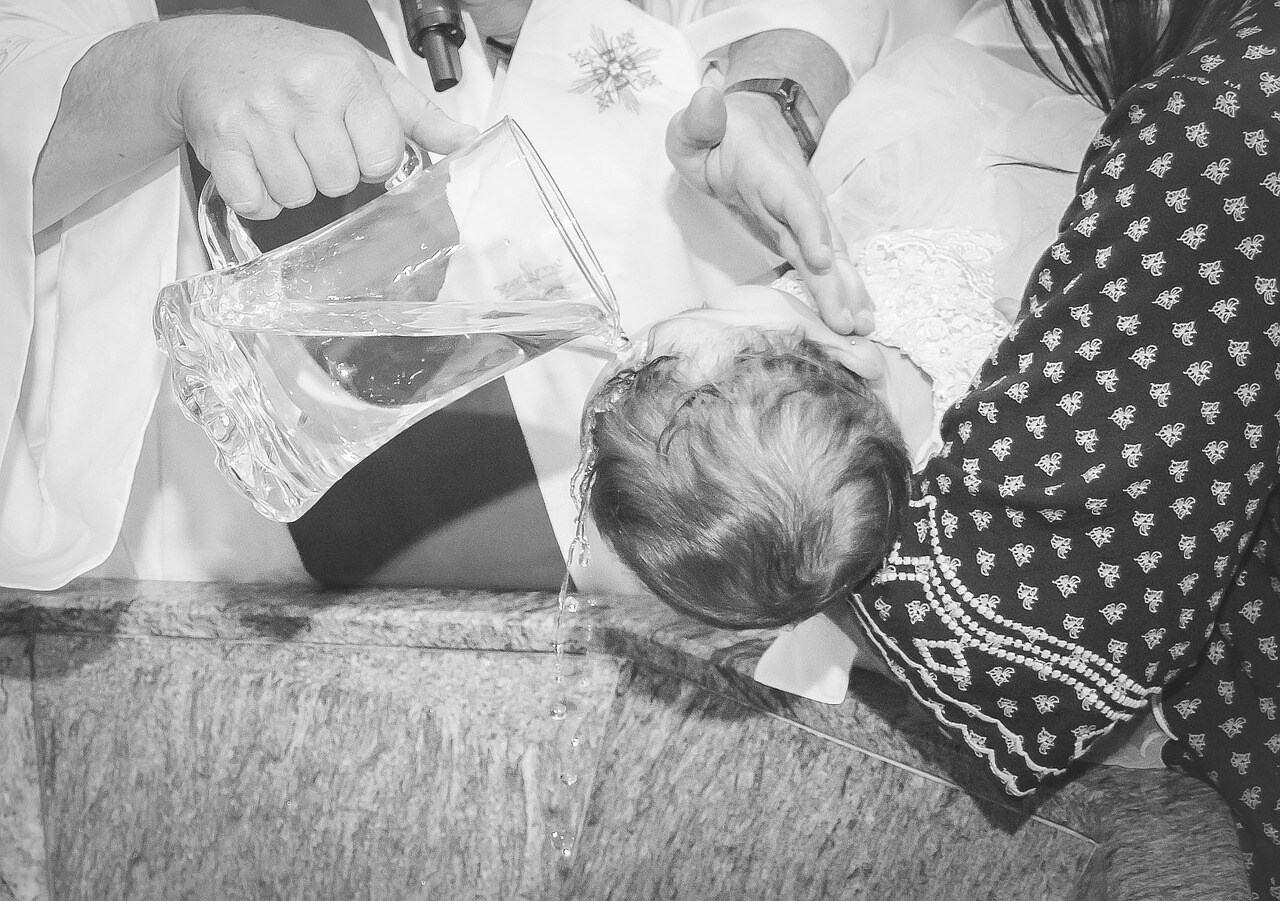
Baptism serves as the first sacrament one receives when entering the Catholic Faith. It is a sacrament of initiation (which you can only receive one time), meaning once you received it, you officially enter into the body of Christ, the Catholic Church. The recipient receives justifying and sanctifying grace when baptized, and the Holy Spirit begins to dwell within them.
St. Paul describes baptism as the “first installment of our inheritance toward redemption as God’s possession, to the praise of his glory” (Ephesians 1:14).
Baptism does five things:
- It forgives all sins that were committed before baptism including original, mortal, and venial sin.
- It makes the baptized a new creature.
- It turns the baptized into a newly adopted son or daughter of God and a member of the Church.
- It brings them to share in the royal priesthood of Christ. (1 Peter 2:9)
- It leaves a spiritual mark (or character) of belonging to Christ on the soul of the baptized.
It serves as the foundation of communion within the Church, and the initiation into Christ’s Body the Church. With this initiation comes a sort of seal, St. Augustine calls it a “character.” This character, which is the fifth thing that baptism does in the list above, is “like a brand imprinted on a soldier that cannot be removed.” The Catechism of the Catholic Church speaks upon this character as well, saying:
“No sin can erase this mark, even if sin prevents baptism from bearing the fruits of salvation … The baptismal seal enables and commits Christians to serve God by a vital participation in the holy liturgy of the Church and to exercise their baptismal priesthood by the witness of holy lives and practical charity” (CCC, 1272 and 1273).
Baptism orients the soul not only to worship God and serve him with their lives, but also to take part in his kingly, prophetic, and priestly offices.
The question of why we have baptisms in the Catholic Faith is easily answered: to gain eternal life. As Christians, we are blessed by baptism. It is the door to the Catholic Faith and the first step we take to pursue eternal life in heaven. This is backed up in Scripture, most notably in John 3 where it is written:
“Unless you’re born again in the water of the spirit, he cannot enter the kingdom of God.”
On these grounds, baptism is believed to be one of four things that are needed for salvation. This also plays into the reasoning of why we baptize our infants: it is to give them the gift of eternal life in heaven, and through our faith that we invite them into salvation.
Baptismal Font
The baptismal font is the large bowl of holy water where most baptisms take place. The word “baptism” itself means “to be immersed.” For the first few hundred years of the Church’s history, baptisms would be done in large natural bodies of water, such as rivers, streams, lakes, and oceans. The earliest baptismal fonts in the Western Church were found in the catacombs of Rome, where indoor baptisms would take place. Baptismal fonts were moved to churches in the fourth century A.D. Most are located at the front of the church, to signify the sacrament as being the “door to the Church.” In fact, we are reminded of our baptismal promises whenever we enter or exit a church. Small baptismal fonts are located at all doors within a church, which we dip our fingers in upon entering or exiting, blessing ourselves in the name of the Father, and the Son, and the Holy Spirit.
Water
Water is the essential matter within a baptism. It is so to symbolize that Jesus is living water, and as we are cleansed during the sacrament, we are welcomed both into the Church and into eternal life. Water is also a symbol of divine life, grace, new birth, growth, deliverance, power, and the covenant God established with his people, first through Abraham.
Baptismal Gown
A baptismal gown is the outfit worn by the one receiving baptism. Traditionally, the gown is white. This is to signify Christian dignity, and the act of becoming a new creature through the sacrament. The color white is also to symbolize being clothed with Christ, as we are cleansed from sin.
Baptismal Candle
The baptismal candle that is lit during the ceremony is also used as the Easter candle. The lighting of the candle represents the flame of faith, which is to be kept burning throughout the life of the baptized. Additionally, the candle symbolizes the risen Christ, as he is the light of the world. The fact that the baptismal candle is also used for Easter is to remind us of Christ’s passion and rising which made the gift of baptism—a full cleansing of original sin, the dwelling of the Holy Spirit within us, and the invitation into eternal life—possible.
The Sacred Chrism and Oil of the Catechumens
Two of the three holy oils are used during a baptism. The first is the oil of catechumens. This oil is used to bless the child before the actual baptism takes place, in order to strengthen the recipient and prepare them for the sacrament. The second oil used is the Sacred Chrism, which is considered the most important of the three holy oils. The Chrism is not only used during the sacrament of baptism, but also during confirmation, holy orders, and at the consecration of a church.
Early on in Church history, this olive oil was used for several different functions, such as welcoming guests into a home, cooking, medicating the ill, preparing a body for burial, and many other practices. The earliest formula of blessing the oils for sacramental use was first found during the fourth century in the Prayer Book of Serapion. The use of the three oils comes from the instructions of Jesus himself, as we see him asking the apostles to anoint the sick (Mark 6:13). The apostles passed this custom on throughout the years (James 5:14-15), giving us the practice of using them still today.
Many of the Church fathers have written on the importance of blessing the newly baptized with sacred oils. The oils are held in vessels called stocks and are placed in an ambry (or cabinet) until they are needed. Chrism is used to consecrate persons, setting them apart for God, while the oil of catechumens is used for those seeking baptism, and the oil of the infirm is used while anointing the sick or dying.
Godparents
The role of the chosen godparents is twofold. First and foremost, they are to act as a source of prayer and example for the child being baptized. Secondly, they are expected to assist in the formation of the child’s faith throughout their life, and, if needed, are available to raise the child in the Faith if the parents cannot. This being said, the faith of the godparents is an extremely important factor in fulfilling the baptismal promise of being raised in the Catholic Faith.