
History of the Catholic Parish of Melton
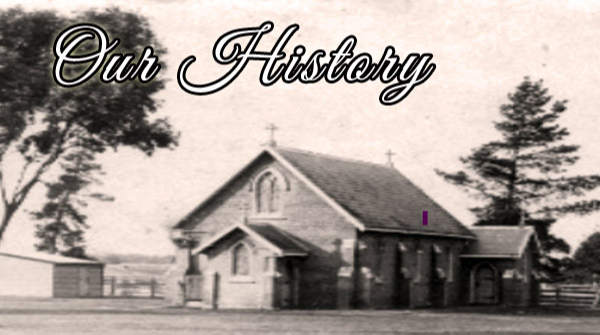
St Dominic’s Church, Melton, is a Catholic Church in the Melbourne suburb of Melton, Victoria, Australia. The church is located at Church St.
THE FIRST CATHOLICS
Of the fourteen Catholics (out of a population of one hundred and twelve) recorded in the 1841 Census of Bourke in an area extending from the Upper Werribee to Penny Royal Creek (Melton), only two were named, W. and G. Pike of Penny Royal Creek. The two brothers, reckoned as being Melton’s first settlers, settled in 1838. They both died in Melton and their graves, surmounted by headstones, are on the Toolern Creek.
THE LAND
In 1855, a combined Protestant Church Committee was formed and began to hold services in the common school. About this time, Fr. O’Connell, Parish Priest of Bacchus Marsh, began to see the need for a Church at Melton. In the Land Department Files of 1861, there is an application by Dr Fitzpatrick V.G. for:
- “two acres in the township,
- and also that Bishop Goold, Rev. E. O’Connell, Thomas Ryan, Michael Bourke and Michael Brady be appointed as trustees”.
The application was granted, and the Government Gazette of 28 May 1861 records that “Lands temporarily reserved from Sale …… for the purpose specified ….. In Melton township Parish of Djerriwarrh and County of Bourke for Roman Catholic Church, Parsonage and School Purposes….”
The church was built in 1877, the “Parsonage” in September 1973 and the School in 1976. Further purchases of land were made in Station Road (six acres) and Melton South (six acres) in the late ’50s.
THE BUILDING
The structure of the Church building, in the beginning, was the same as it is today, except that in the style of the day, it had a choir gallery and a confessional. The site was fenced with a five-rung slip rail fence. Stables were provided for the Priest’s horse. During the term of Fr. Ellis (the first Priest to travel by car from Bacchus Marsh), the stables were dismantled, and the timber was used to build the first tennis pavilion. The northern vestry was added in the late 1940s, and in 1952 electricity was connected to the church.
Stained glass windows depicting The Crucifixion, The Annunciation, The Birth of Christ and The Assumption have been fitted over the years.
In 1939 Stations of the Cross made of wood and painted white were hung. The confessional, choir gallery, and side altars have been removed to make more room. The original centre altar, following Vatican II, was replaced by a table altar.
LAYING THE FOUNDATION STONE
Archbishop Goold laid the foundation stone on 26 November 1876. That he laid the stone is certain, that he laid it well is also certain, for no trace of it can be seen today. Some 34 children were confirmed on foundation day in an open-air ceremony – the only confirmation until Archbishop Little confirmed 53 young parishioners in the Mechanics Hall on Wednesday, 18 September 1974. This was Archbishop Little’s first visit to Melton since being erected as a parish.
AT THE BEGINNING OF A CENTURY
On Sunday, 25 February 1877, Archbishop James Alipius Goold, Archbishop of Melbourne, dedicated the newly built Church at Melton. St. John Chrysostom’s was the name the Archbishop gave to the latest addition to his archdiocese. When and why the name was changed is not recorded, but by 20 March 1897, The Advocate reported, “Besides St. Bernard’s, there are three other churches in the parish, St. Dominic’s (Melton), St. Malachy’s (Blackwood) and St. Michael’s (Blackwood East).”
The cost of the building was £1,400. A collection was taken up, which realised £60, and some four hundred tickets sold at seven shillings and sixpence. The Bacchus Marsh Express thought that the Church “adds considerably to the appearance of Melton.”
CARRYING ON THE FAITH
From the 1890s up until about 1915, nuns from St. Joseph’s Convent in Bacchus Marsh travelled down by train to Melton each Saturday afternoon to give Religious Instructions to the children. Parishioners took turns to drive them to and from the station. Sister M. Ursula McFarlane, who travelled down in 1909, 1910 and 1911, recalls, “I used to enjoy the outing. Mrs Jongebloed always had a delicious afternoon tea ready for us and also a parcel of goodies to take home.”
Later, the ladies of the parish took over from the nuns. Miss Nora Smith cheerfully carried out the task almost singlehanded for some 36 years, and then, as the numbers increased, the work was taken over by a band of Catechists. Now that many children attend Catholic Schools – their role has become more vital – and they carry the Faith to the children in the Government Schools by way of Sunday Religious Instruction Classes and by visiting the schools.
VOCATIONS
Fr. William Casey is Parish Priest at Alphington. His mother, Mary Casey, was the first child baptised in St. Dominic’s. Monsignor Frank McGuire, who, at the time of his death in 1968, was Dean of Kyneton, is buried in the Melton Cemetery. Sr. M. Francis Coburn teaches at Mount St. Joseph’s Secondary School in Altona West, and since St. Dominic’s has been a Parish in its own right, Dianne Millington has joined the Sister of St. Joseph. Archbishop Little’s father was, in the 1930s, the Shire Engineer of the Melton Shire.
EDUCATING OUR CHILDREN
The first Catholic School was opened on 1 January 1862 and was called St Catherine of Siena on the Kororoit Creek (behind Stockwell Stud). The school was a shingle-roof wooden building, 40’ x 18’, with thirty-five children paying One Shilling per week in tuition fees.
The teacher was a layman, Mr James Wallace, who at one time taught at St. Mary’s Williamstown. The school closed in 1875 because of lack of numbers. It was destroyed by fire two years later.
St Dominic's was the second Catholic School in the area. It opened its doors on 3 February 1976, in Church Street, Melton, in a building comprising eight modern classrooms, an administration and staff area and a tuckshop. The Principal was Mrs Joan Woodhouse.
During that time, it was expected that the school would increase in enrolment to 340 pupils. Hence in 1979, St Anthony's Primary School in Melton South was opened with Liz Coustley as the inaugural principal. In January 1983, St Anthony's came under the jurisdiction of the newly erected parish of Melton South. In the same year, the second Catholic primary school bearing the name St Catherine of Siena was established in Melton West with Joan Woodhouse as the principal.
In 1976 a Secondary Education Development Plan was launched by the Catholic Education Office, Melbourne. It did not, however, make provision for a secondary school within the St Albans area. This was raised by Frs John O’Reilly and Anthony Guelen at a meeting with the CEO later that year with the observation that there were already over 1000 students in parish primary schools in the area, and more than 100 ready to enter secondary school.
Within a year, the parishes of St Albans, Melton, Bacchus Marsh, Sunbury and Airport West met with Bishop J. O’Connell to consider how they might meet the educational needs of their young people. In March, a planning committee was established to pursue Catholic Secondary Education for the area.
While the St Albans campus could now serve the students in its surrounding area, those from Bacchus Marsh and Melton were still without a Secondary College. In 1979, planning for a further Year 7–10 college at Melton began. CRC Melton opened in February 1980 at St Dominic’s Hall, moving to its present site in Bulmans Road in March of that year. Sr Helen Reed was the principal.
In 2023, CRC Melton became independent from the CRC Federation and changed its name to St Francis Catholic College. A second campus also opened that year in Cobblebank.
THE PARISH
On Sunday, 28 May 1972, not long after its 95th Birthday, St. Dominic’s became a Parish Church. Fr. Donegan, from Bacchus Marsh, was appointed as Parish Priest. Fr. Donegan made his headquarters in the Southern Vestry of the Church, returning to Bacchus Marsh in the evening.
In September 1973, Fr. Donegan moved into the new Presbytery at the corner of Unitt Street and Smith Street. The Presbytery comprises a Parish Meeting Room, two Counselling Rooms and accommodation for a Parish Priest, a curate and a housekeeper. On 18 June 1972, a Concelebrated Mass was held in the Mechanics Hall to mark the beginning of the Melton Parish. The concelebrants were Fr. Donegan, Fr. Steele (Parish Priest of Bacchus Marsh) and Fr. William Casey (born and raised in Melton).
THE 100 YEARS IN BETWEEN
Looking around, what was the old Bacchus Marsh Parish? St. Malachys at Blackwood and St. Michaels at Blackwood East are no more. Churches at Comaida and on the Kororoit Creek have so long disappeared it is challenging to establish they existed. Our Lady Help of Christians, built in 1903 at Korobeit, continues its lonely vigil over mountains and valleys. St. Bernards at Bacchus Marsh has gracefully grown and prospered over the years.
And until the 1970s, the world seemed, in a material sense, to be passing St. Dominics by. But the 100 years in between, if not marked by lavish building works, were noticeable for able pastors, devoted catechists and happy, contented parishioners living out sturdy Catholic lives.
THE FAMILY TREE
1839 – 1848 Part of Port Phillip Mission ( Victoria)
1848 – 1854 Part of Keilor Mission
1854 – 1871 Part of Bacchus Marsh Mission
1871 – 1878 Part of Gisborne Mission
1878 – 1972 Part of Bacchus Marsh Parish